
What does “good enough” look like in a sector that values perfectionism?
At Data+Soul, we explore this question every day as we grapple with the tension between what we're proud to put into the world and the edge of what could always be better. This shows up both in our evaluation practice and in how we have evolved the structure and governing practices of our organization over the past five years. This article focuses on the latter.
As a small business, we celebrate the diversity of perspective brought by our teammates and recognize that it takes strong collaborative relationships and time within our day-to-day to re-examine the deep-rooted social science research and funding/nonprofit practices that fill our resumes, and bring these into alignment with our own real-world, messy understanding of how people come together to make decisions and help one another thrive. From an organizational perspective, these requirements often sit in tension with the realities of sustaining a business within a sector that runs on stretched dollars and systems (we’ll name it: capitalism, nonprofit industrial complex) that prioritize financial profit, glorify sacrifices made for “the cause”, and value perfection. In other words, the blueprints most readily available to us do not build the house we want to live in. It has necessitated extra effort to identify and learn from other models to guide our organization’s own evolution.
Our overarching goal in this journey has been to better root our organizational practices and infrastructure in the same principles of equity that guide our consulting practice. To explore these aspects of our organization, we leveraged Frederic Laloux's Reinventing Organizations, which offers a compelling vision for the future of how work gets done through evolutionary organizing principles it calls “Teal.” This piece shares what Data+Soul is learning as we borrow ideas from this framework, what expectations we released, and why we now think "good enough to try" is a more realistic goal than completion.
Background on Teal
A quick orientation if you’re not familiar with the framework. Laloux describes stages of organizational development seen throughout history, each with its own logic and assigned color. "Orange" organizations are highly visible in today’s United States. They run on performance targets, hierarchy, and measurable achievement, as seen in the business community and many of the organizations and institutions we work alongside. “Green” organizations are structured around values, seeking harmony, and the needs of stakeholders, which is akin to the community-based organizations we engage with. "Teal" is an emerging organizational model that views organizations as living systems that are self-managed, invite people to bring their whole selves to work, and leverages the wisdom and perspective of the team to determine its evolutionary purpose. In practice, these three elements enable the organization to discover its direction over time, rather than dictate one from the top down. This model reminded us of adrienne marie brown’s offerings in Emergent Strategy where she alikens the work of systems change organizations to a flock of starlings where movement is coordinated through shared understandings and responsiveness to their environment. The book makes the case that the “teal” model serves as an antidote to leadership burnout, employee disengagement, and strategic plans that become outdated soon after they are published.
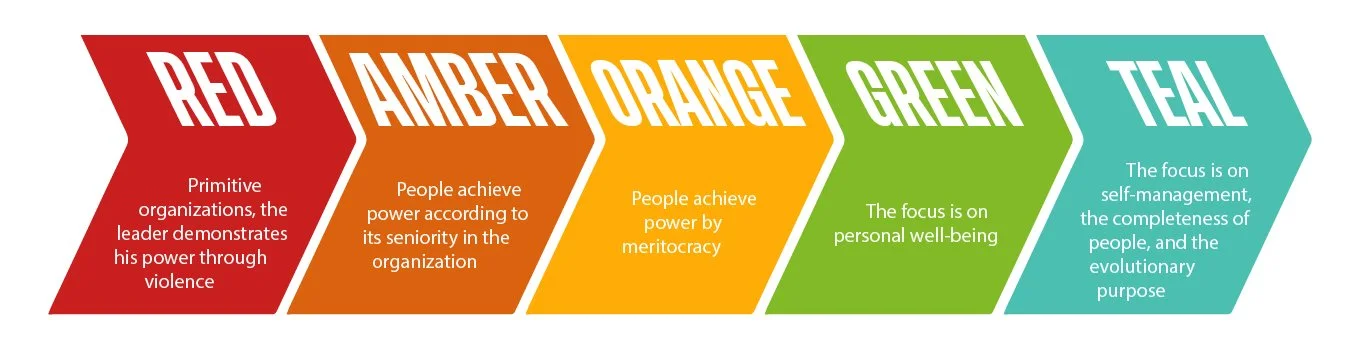
Image: Basetis, “TEAL evolution,” via BasetisNow
Our founder, Min, first came across the framework in conversations with peers at other firms who have applied it to their own organizations. She brought it to our team, and our Operations Manger, Red Fong, gravitated toward it right away. As the steward of team culture at Data+Soul, Red builds containers and protects time for team discussion, like monthly reflective practices and conversations that help us ask deep questions of each other, so that we can better align our approaches to our firm’s mission and values. Red and Min wanted to ensure that Data+Soul is a workplace where everyone can speak up and bring their expertise into the room. They also wanted to ensure the team’s decision-making processes actually reflect the values we espouse (a friction that many “Green” or values-based organizations grapple with). Clarity around these processes was particularly important in the face of recent major upheavals to the social sector. These required clear articulation of the tradeoffs of being made by the business we navigated the upheavals, and how much power and influence our colleagues had on decisions that affected everyone.
Exploring Teal gave us a way to investigate where those boundaries were.
What Teal offers: a shared vocabulary
The most useful thing the framework gave us was shared language. Self-management, wholeness, and evolutionary purpose helped us see where we were already strong and where we needed to stretch.
Going into this exploration, we knew that wholeness was our strong suit. We bring somatic practices into our team meetings, make room for personal and lived experience, and encourage each other to set boundaries. We found self-management and evolutionary purpose to be harder to identify in our organizational structures or practices. How does evolutionary purpose work in a firm owned by one person, while still taking real input from the team? And where were we modeling and enabling self-management, and where were we falling short?
What we built: Strategic directions for the year, but not a full-fledged plan
We took those questions to the whole team and invited everyone into a sensing and visioning process built around scenario planning that would lead to a short-cycle strategic plan for the year. Each person brought what they were noticing in the world and in our sector, and we asked how those shifts might affect the organization's pillars. This scenario planning process directly shaped our plan for 2026 and also supported each team member’s understanding a) the “why” behind our strategic decisions and b) how their roles and professional goals fit in.
What we built: our Ways of Being
A big part of our Teal exploration became writing down how we want to work together. Over 2025 and 2026, each of us reflected on our commitments to the organization, to one another, to the clients we serve, and to the communities behind the data. Those reflections became our Ways of Being.
We picture Data+Soul as a single-celled organism with many organelles, each with a specific function, moving through a large ecosystem. It reaches toward opportunity while keeping its cell walls. The Ways of Being are those walls. They shape how we make decisions, staff projects, handle conflict, and show up day to day, and we treat them as living agreements that we renew as the firm and the people in it change.
Each Way of Being names what it looks like in practice for an individual, for the team, and for the firm. Each one also names its trade-offs and gives examples of what being in and out of alignment looks like. That structure answers a question we kept returning to: where do I have power and a say, and what should I trust others, or all of us together, to hold? The Ways of Being have since served as a clear guide for other major infrastructure projects affecting the team. Our brilliant HR partner, Joann Lee Wagner, helped us distill the implications of our Ways of Being into updates of our employee handbook, benefits structure, performance review system, and other company policies.
Wholeness, with a choice built in
Writing our Ways of Being together taught us something about wholeness. It surfaced where the boundaries are between us, and how much each person is comfortable being held accountable to. It also reminded us that the highest bar, or the most "revolutionary" mindset, is not always the best fit for the entire team.
As we continue to navigate political and cultural changes that impact our personal and professional lives, we recognize that not everyone needs to bring every part of themselves to work. We all have complicated lives and other places for reflection, support, and organizing, and our workplace doesn't have to meet all of those needs. Saying so permits people to decide how much of themselves to share without shame. It also released a quiet expectation that Data+Soul would be the place for everyone to take action.
For us, that is what wholeness looks like when it's practiced well: people getting to choose, not being forced to put everything on the table to meet a cultural expectation.
Where we push back
Teal didn't fit us cleanly, and investigating where it didn’t serve us offered clear conclusions for decision-making and advice-seeking practices. We found two chief criticisms of the framework as Laloux presents it.
Criticism one: All or nothing
Laloux's picture can read as if you either have full buy-in and adoption, or you don't have Teal. As evaluators, we are used to tradeoffs and consequences. Changing how we convey an outcome changes how a client can take it in—choosing which outcome to go deeper on means setting aside other salient trends. Nothing we do is neutral, and our own structure is no different.
So we blend, and we name what each choice costs:
Self-management. Team members do not have full autonomy over what projects they take on. Instead, we assign team members to projects based on their skills and known interests while providing opportunity for feedback and recalibration during project after action reviews. This eases coordination time.
Evolutionary purpose. As the owner and principal, Min is ultimately responsible for deciding the firm's direction. We have infrastructure that articulates the values and beliefs that guide our decisions and we regularly invite team input, but the team is able to stay focused on their work without having to carry the emotional weight of every big decision.
Wholeness. Described above.
This is where we practice a blend of stages. We don't treat the blend as a failure to be fixed. It's a set of choices we try to make on purpose.
Criticism two: A ladder of development
Laloux's model applies a linear progression of time and development. It places Indigenous worldviews in an earlier "magic" or "mystic" stage, as something organizations and communities grow beyond. Red argues they belong in what comes after Teal.
Outside of Data+Soul, Red is a facilitator and consultant for organizations looking to align their organizational practices with their stated values. As part of this work, they infused Reinventing Organizations into plans for the Relearning Cohort, a program offered through Momentum Conservation that brings together place-based organizations working in conservation and environmental justice. Due to the nature of these organizations and their relationships to Wabanaki communities, the organizations often invite a decolonial lens to learning. This audience pushed Red to probe more deeply into how Indigenous paradigms fit into a Teal organization.
Two questions that stood out:
What place do mythologies have in a Teal paradigm? Stories ground values. Without them, values can become words on paper. Non-native institutions have stories about their work and purpose too. Still, we tend to file them as institutional knowledge or praxis, and we hold them to a different standard than colonial worldviews apply to Indigenous storytelling.
Who counts as a stakeholder? Teal's advice-and-consent processes assume participants who can show up and speak. If we consider the Earth and its inhabitants as relatives with a stake in our decisions, we have to ask what it would look like to seek the advice of the place we live when we decide.
Even after considering these, we don't have clean answers. We think the questions belong in the conversation about what organizations can become.
Now what: good enough
If we could hand one idea to another small team, it would be this: aim for good enough. Perfectionism is something we wrestle with at Data+Soul, and finding a happy medium with “good enough” decisions or new ideas framed as “experiments” has mattered.
We spend a lot of energy chasing a milestone or the right to claim a title. A framework that holds a high bar, or insists you can't have Teal without complete adoption, can quietly teach us to wait until we can do it perfectly. That's misleading. The more useful move is to find what works for your team and fold small pieces into the constellation of practices you already have. For organizational leaders out there, let the framework challenge you. Don't punish yourself when you can't reach perfection or completion. Instead, use it as data to inform the next round of adaptations.
If you're experimenting with something similar, or if your own practice offers a different answer to the questions above, Min and Red would love to hear from you!
